Perceive Chinese Art Warm silent World
“感知中文艺术,温暖无声世界”
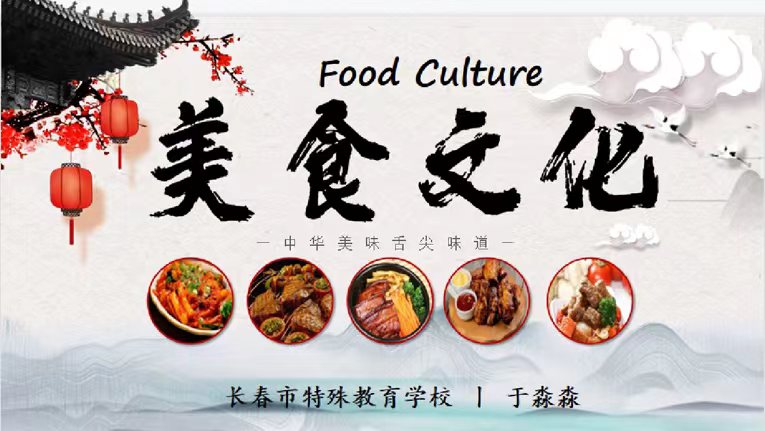
Food Culture
美食文化
Course Syllabus 课程章节
2Traditional Chinese Festivals introduces the food customs of Chinese New Year, Lantern Festival, Dragon Boat Festival and Mid-Autumn Festival. The explanations of videos and pictures give students a brief understanding of the food customs of Chinese festivals and the lively scene of purchasing food and goods before Chinese New Year, which can better stimulate students’ interest in learning. The dietary differences between southern and northern Chinais explained through pictures so that students can learn that wheat can be ground into flour to make buns, dumplings, cakes and other dishes. Paddy ground into rice can make various staple foods, such as: fried rice with eggs, claypot rice, etc. The following eight major cuisines are recognized as the most influential and representative of the Chinese cuisine, namely Sichuan cuisine, Guangdong cuisine, Jiangsu cuisine, Zhejiang cuisine, Hunan cuisine, Anhui cuisine, Huaiyang cuisine and Fujian cuisine. Using a map of China showing the location of the above eightcuisines and then showing the representative dishes of them, we briefly introduce the characteristics of the eight major cuisines. There are many ways to cook in China. Using a picture and a small video to let students visualize the cooking methods such as stir-frying, deep-frying, stewing, frying, braising, boiling, steaming, baking, pickling, plucking, and sweet and sour. The common seasonings of onion, ginger, garlic, soy sauce, vinegar and some other ingredients can also be taught in the same way. The video "Chrysanthemum Tofu" is shown in the course giving students a taste of the classic Chinese cuisine made with the finest knife skills.The “Sugar Figure” culture is a traditional Chinese handicraft with a long history, in the past it was a favorite toy and food for children, and now it has been developed into a traditional Chinese folk art. The “Fondant Cake”is a very artistic and ornamental cake that can be made in different shapes, so it is full of crafts. These three videos can let the children experience theskills of traditional Chinese craftsmen. Chopsticks are one of the traditional Chinese tableware with a long history and a rich cultural connotation. The top of chopsticks is square and the bottom is round, which means that the heaven is round and the earth is square, reflecting the idea of “unity of heaven and man” advocated by Chinese culture, and there is a certain etiquette for using chopsticks. Many traditions have been preserved at the Chinese dinner table,, such as “Dian Dao Wei Zhi”, “rising salute”,“propose a toast and drinking it with respect” and “persuading the eating of food but do not pick up the food”, etc. These contents are played through the videofor students to have a simple understanding of these culture.
中国的传统节日介绍了春节、元宵节、端午节和中秋节的食俗,视频和图片的讲解,让学生对中国节日的食俗有简单的了解,感受中国春节前购置年货的热闹场面,更能激发学生的学习兴趣。中国南方和北方的饮食差异,通过图片讲解让学生懂得小麦磨成面粉可以制作出包子、饺子、饼等丰富的面食。稻子磨成大米可以做出各种主食,蛋炒饭、煲仔饭等。中国的菜肴在社会公认中最有影响最有代表性的八大菜系,分别为川菜、粤菜、苏菜、浙菜、湘菜、徽菜、淮扬菜,闽菜,用一幅中国地图上展示各个省的位置,再出示各大菜系的代表菜品,简单介绍八大菜系的特点。中国烹饪的方式很多,用张图片和小视频让学生直观感受爆炒、炸、焖、煎、烩、煮、蒸、烤、腌、拔丝、糖醋等烹饪方式 。常用的调味料葱、姜、蒜,酱油、醋还有一些配料也用同样的方式让学生学习。
课程里出示的视频“菊花豆腐”细如发丝,让学生感受中国极致的刀工所成就的经典美食;“糖人”文化是一项有着悠久历史的中国传统手工艺,在过去是孩童们喜爱的玩具和吃食,发展至今已成为了一项中国传统民间艺术;“翻糖蛋糕”是一种极具艺术观赏性的蛋糕,可以制作出不同的造型,所以工艺性更强。三个视频的播放让孩子们感受中国传统手艺人的绝活。筷子是中华民族传统餐具之一,有着悠久的历史,更蕴含丰富的文化内涵。筷子上方下圆,寓意天圆地方,天长地久,体现了中华文化倡导的“天人合一”的思想,使用筷子也有一定的礼仪。在中国餐桌上保留了许多传统,如点到为止、起身礼、正敬侧饮、劝菜不夹菜等宝贵的礼仪文化,这些内容通过小视频的播放让学生有简单的了解。
General Courses 通用课程